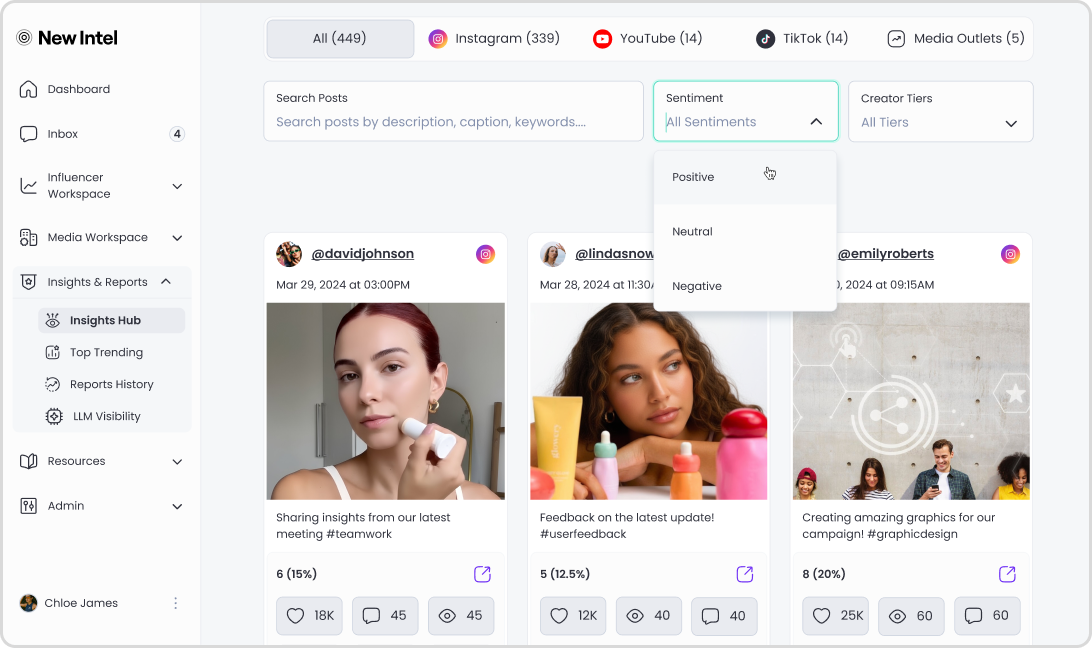
Sentiment analysis — also known as opinion mining — is the use of natural language processing (NLP) and machine learning to identify and categorize the emotional tone behind text. In a marketing context, sentiment analysis is used to determine whether social media posts, reviews, news articles, and other content mentioning your brand are positive, negative, or neutral.
At its most basic level, sentiment analysis answers the question: how do people feel about my brand? But advanced sentiment analysis goes much deeper, identifying specific emotions, detecting sarcasm and irony, understanding context, and breaking down sentiment by topic, audience segment, and time period.
Modern sentiment analysis engines use machine learning models trained on millions of labeled examples of human language. These models learn to associate certain words, phrases, and linguistic patterns with positive or negative sentiment. When new content is processed, the model applies this learning to assign a sentiment score.
The best sentiment analysis systems — like the one powering New Intel — are trained on domain-specific data. A general-purpose model might struggle to understand that in certain industries, words like 'aggressive' or 'disruptive' are positive, not negative. Domain-specific training produces significantly more accurate results for marketing use cases.
Product feedback: Aggregate sentiment from reviews, social posts, and support tickets to understand how customers feel about specific product features — and prioritize improvements accordingly.
Campaign measurement: Track how sentiment shifts before, during, and after a marketing campaign to understand its emotional impact on your target audience.
Competitive intelligence: Analyze sentiment toward your competitors to identify weaknesses in their customer experience that you can exploit, and strengths that you need to match.
Crisis detection: Monitor for sudden shifts toward negative sentiment that could signal an emerging issue before it becomes a full-blown crisis.
Customer service: Route high-priority negative mentions to your customer service team in real time so they can respond quickly and prevent escalation.
No sentiment analysis system is perfect. Sarcasm, irony, cultural nuance, and highly domain-specific language can all trip up even the best models. It's important to use sentiment data as one input among many, and to periodically audit your results manually to ensure accuracy.
The best approach is to use sentiment analysis to identify patterns and trends at scale, then apply human judgment to individual cases that require nuanced interpretation.
Built on IMAI's infrastructure - A Stagwell Company
(NASDAQ: STGW).